Case study 03Cyber-physical test field

Drone swarm
& MoCap

Making coordinated autonomy measurable, observable, and repeatable.

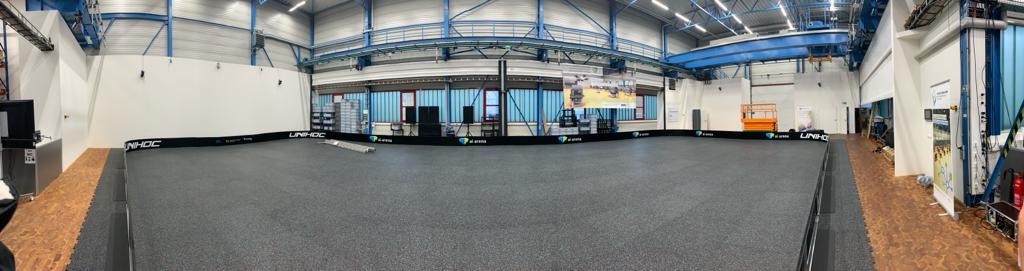
Panoramic view of the FLW cyber-physical research hall and its open test area.
Panoramic view of the FLW cyber-physical research hall.Project archive

The test field

A logistics hall turned into a measurable digital space.

From 2017 onward, TU Dortmund's Chair of Material Handling and Warehousing transformed its research hall into a cyber-physical test field. Motion capture, RGB sensing, projection, mobile robots, and autonomous drones enabled precise indoor experiments without fixed transport infrastructure.

54
infrared cameras
8
RGB cameras
mm
tracking precision
≤ 12
UAVs in Patrick's experiments

Attribution

Team achievement

A shared cyber-physical research facility.

The FLW team built a flexible environment for motion tracking, robot control, human-activity research, digital twins, and autonomous transport. Its drone demonstrator assigned virtual parcels to nearby aircraft and coordinated shared tasks in a swarm.

My contribution

Commissioning and coordinated flight experiments.

I contributed to commissioning and integrating the 50+ camera motion-capture system and worked on experiments with a coordinated swarm of up to twelve indoor UAVs. This was team research within the FLW Innovation Lab, not a solo development.

Experimental loop

Observe, coordinate, validate.

01

Track

Capture vehicles and objects throughout the hall.

02

Estimate

Turn observations into millimeter-precise states.

03

Assign

Allocate virtual transport tasks to nearby UAVs.

04

Coordinate

Move, avoid obstacles, and cooperate as a swarm.

05

Validate

Compare autonomous behavior with reference data.

Public evidence

The facility and research are documented by TU Dortmund.

The sources verify the camera setup, millimeter-precise tracking, self-organizing transport drones, and the cyber-physical-system demonstrator. The figure of up to twelve drones is identified as a CV-backed personal detail.

Back to case study 01LoadRunner